



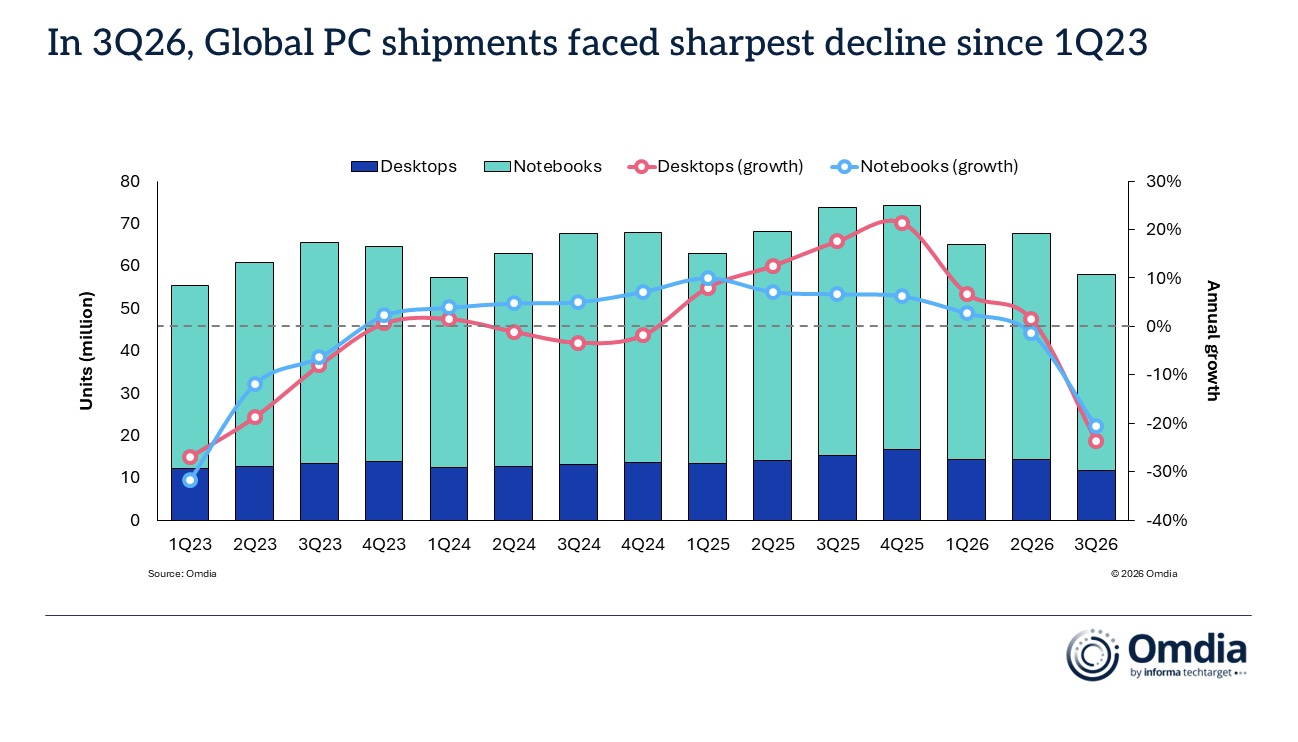
Global PC shipments declined 21.2% year over year to 58.1 million units in the third quarter of 2026, marking the market’s steepest contraction since Q1 2023. According to Omdia, the downturn reflects fading demand from earlier purchasing activity, rising component costs, higher retail prices, and continued inventory adjustments across the supply chain.
Global shipments of desktop computers, notebooks, and workstations fell sharply in Q3 2026 as the effects of accelerated purchasing in the first half of the year began to fade. Research from Omdia, published on October 9, puts total shipments at 58.1 million units, down 21.2% from the same period in 2025.
Desktop shipments, including desktop workstations, declined 23.5% year over year to 11.7 million units. Notebook shipments, including mobile workstations, fell 20.6% to 46.4 million units.
The latest figures point to a challenging period for PC manufacturers as demand weakens while higher component costs continue to put pressure on pricing, production planning, and channel inventory management.
Pull-Forward Demand Fades as Higher Prices Pressure Sales
According to Ishan Dutt, Research Director at Omdia, the sharp decline follows a period of accelerated purchasing that supported the PC market during the first half of 2026. As that demand subsided, shipment volumes fell in line with expectations previously communicated by major manufacturers.
Leading PC vendors had already warned of double-digit unit declines in the second half of the year during their latest earnings cycles. Retailers also reported higher average selling prices alongside weaker sales, indicating that rising costs were affecting consumers’ willingness to purchase new devices.
The impact of higher upstream component costs has increasingly filtered through to retail prices, prompting consumers and enterprise IT buyers to reassess purchasing decisions. In response to weakening demand, PC vendors and their original design manufacturing (ODM) partners began reducing production during Q3, while distribution partners continued working to clear elevated inventory levels.
Memory and Storage Costs Put Pressure on PC Pricing
Supply chain conditions have become increasingly difficult in recent months. Continued increases in memory and storage prices, combined with shortages of processors, graphics cards, and other integrated circuit components, have complicated procurement, production planning, and inventory management for PC manufacturers.
Ben Yeh, Principal Analyst at Omdia, said DRAM and solid-state drive (SSD) costs have become a significantly larger share of total PC material costs. Their combined share has risen from a typical level of approximately 15% to nearly 40%, while prices have increased more than fourfold.
Although PC vendors have raised retail prices several times over recent quarters, those adjustments have not fully offset the additional costs. Manufacturers therefore face a difficult balancing act: passing further increases on to customers risks weakening demand, while absorbing the costs puts additional pressure on margins.
Omdia expects these challenges to persist, potentially extending the current market contraction. The research firm forecasts global PC shipments to decline 24% year over year in Q4 2026, followed by a further 7% contraction for full-year 2027.
Lenovo Maintains the Lead as HP Records the Sharpest Decline
Despite widespread double-digit shipment declines among leading vendors in Q3 2026, the global PC rankings remained largely unchanged both sequentially and year over year.
Lenovo retained the top position, shipping 14.9 million units and capturing 26% of the global market. HP ranked second with 10.3 million units, representing an 18% market share. However, HP recorded the steepest decline among the top five vendors, with shipments falling 31% year over year. Its market share also dropped by nearly three percentage points compared with the same quarter in 2025.
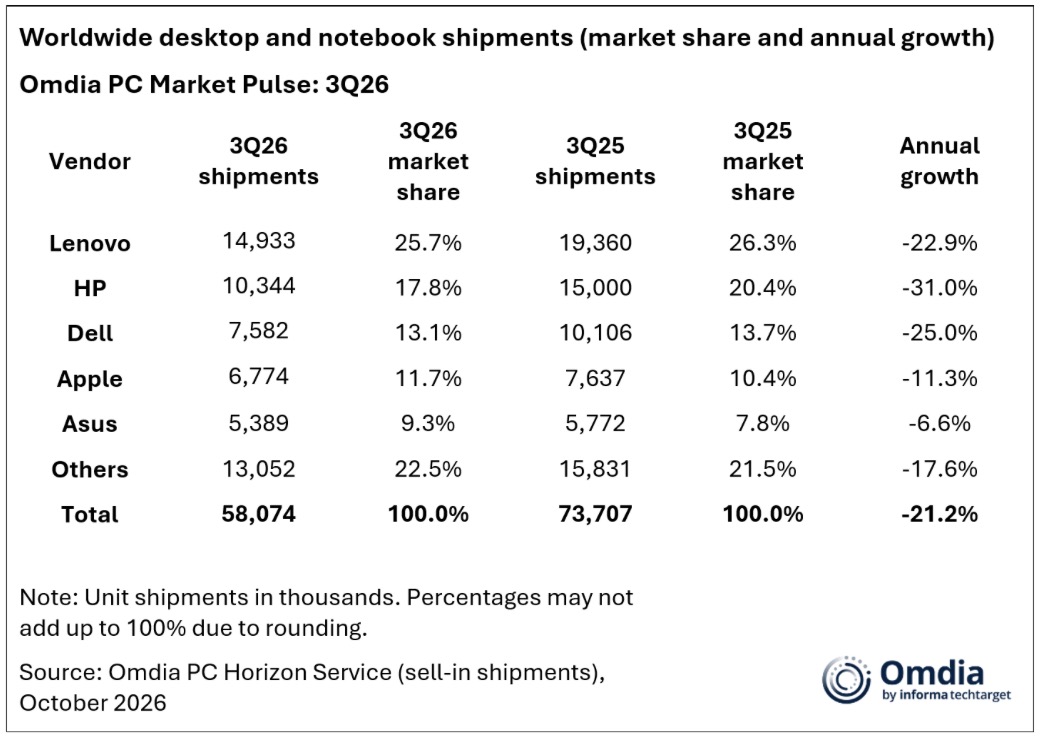
Dell maintained third place, shipping 7.6 million units and accounting for 13% of the market. Apple ranked fourth with 6.8 million units, down 11% year over year. Despite the decline, Apple gained more than one percentage point of market share, as its premium market positioning helped limit the impact of higher prices.
Asus completed the top five, shipping 5.4 million units. The company recorded the smallest shipment decline among the leading vendors, while its market share increased to 9.3% year over year.
PC Market Faces Further Challenges Through 2027
Omdia’s latest findings suggest that the PC industry is entering a period of adjustment following the accelerated purchasing activity seen earlier in 2026. Weakening demand, rising component costs, higher retail prices, and excess channel inventory are combining to create a more challenging operating environment for manufacturers.
With shipments expected to decline further in Q4 2026 and throughout 2027, vendors will need to balance pricing strategies with consumer demand while managing production levels and inventory more carefully. Their ability to control costs and maintain competitiveness as component prices remain elevated could become a key differentiator in the coming quarters.