



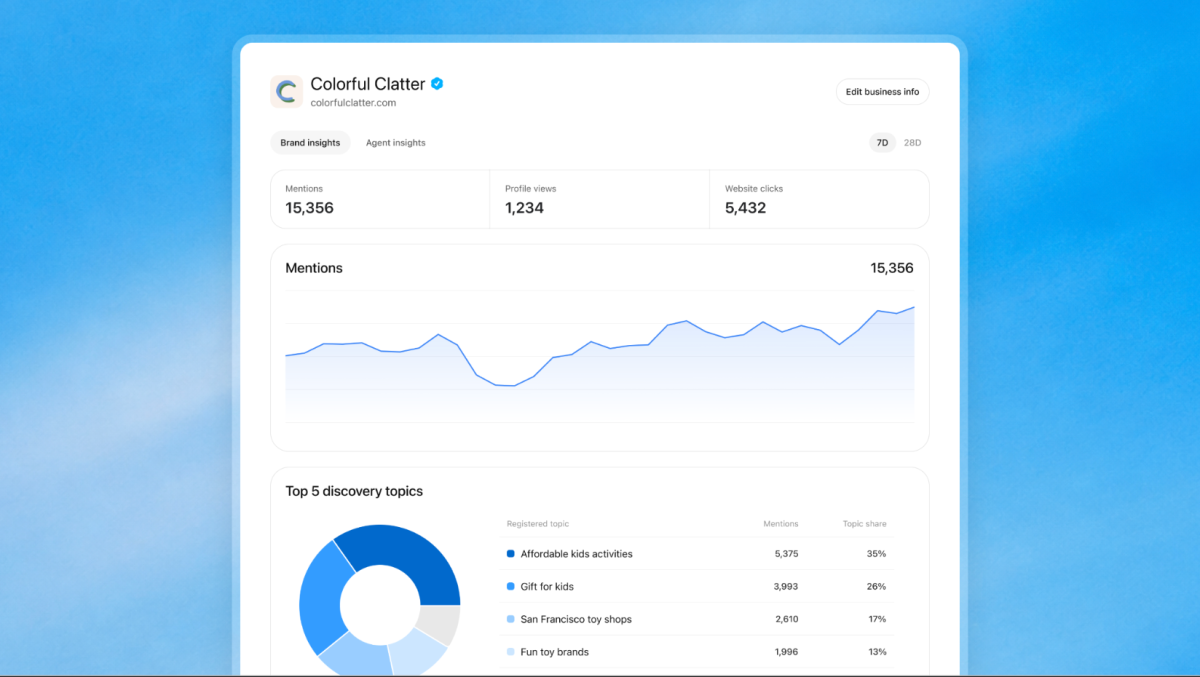
OpenAI has launched the Business Hub, a beta feature that enables companies to set up verified business profiles and specialized AI agents on ChatGPT, providing basic user interaction analytics.
Business Hub lets companies build verified profiles
On Tuesday, OpenAI announced the Business Hub, a new beta platform that allows companies to create and manage business profiles within ChatGPT. The profiles contain product descriptions, service details and contact information, giving users quick access to essential data. By embedding these listings directly in the conversational AI, OpenAI aims to turn ChatGPT into a discovery engine similar to traditional search services. The feature is currently available to eligible businesses in the beta phase.

To ensure authenticity, each profile must pass a formal verification process, although OpenAI has not disclosed the exact steps. Benji Shomair, OpenAI’s VP of Monetization, said the company employs multiple verification methods tailored to different business types and markets. The process is intended to prevent misinformation and build user trust. Once verified, a company’s profile appears in ChatGPT’s internal search results when relevant queries are made.
Dedicated business agents and user analytics
In addition to static profiles, the Business Hub enables firms to launch a specialized business agent. Users can ask the agent questions about products, services, or company policies, receiving answers generated by ChatGPT’s language model. This conversational interface offers a more dynamic way to convey information without requiring businesses to develop their own chatbots. The agent operates within the same ChatGPT environment, ensuring a seamless user experience.
The hub also provides a limited analytics dashboard reminiscent of Google Analytics, but focused on ChatGPT interactions. Companies can track profile views, mentions, website clicks and other engagement metrics. These insights help businesses understand how users discover and engage with their content. At present the data is presented in a basic format, with plans to expand the reporting capabilities in future releases.
Strategic shift toward a Google‑like discovery model
Earlier this year, OpenAI attempted to turn ChatGPT into an e‑commerce hub, offering direct product purchases and a commission‑based revenue model. The initiative, which included a checkout cart feature, was discontinued in March after failing to gain traction. The launch of Business Hub signals a pivot from direct sales toward facilitating information exchange between users and businesses. This approach mirrors Google’s long‑standing role as the primary gateway for consumers researching companies before buying.
The ultimate impact of the Business Hub will depend on how quickly businesses adopt the verification process and how users embrace the new capabilities. A rapid increase in verified listings could position ChatGPT as a go‑to platform for product discovery. Nonetheless, the service faces stiff competition from established search engines and emerging AI assistants. TechTimes will monitor market response and adoption rates in the coming months.
TechTimes analysis
TechTimes believes the Business Hub marks a notable shift in OpenAI’s monetisation strategy, moving from a direct e‑commerce model to a discovery‑oriented service. By allowing verified business profiles and AI‑driven agents, ChatGPT can capture a slice of the search‑driven traffic that currently fuels Google’s advertising engine. The limited analytics give companies a glimpse of user interest, which could evolve into a more robust data product. Success will hinge on the breadth of verified listings and the willingness of users to rely on ChatGPT for preliminary research. Observers should watch for expanded analytics, pricing structures for premium features, and any integration with external advertising platforms.