



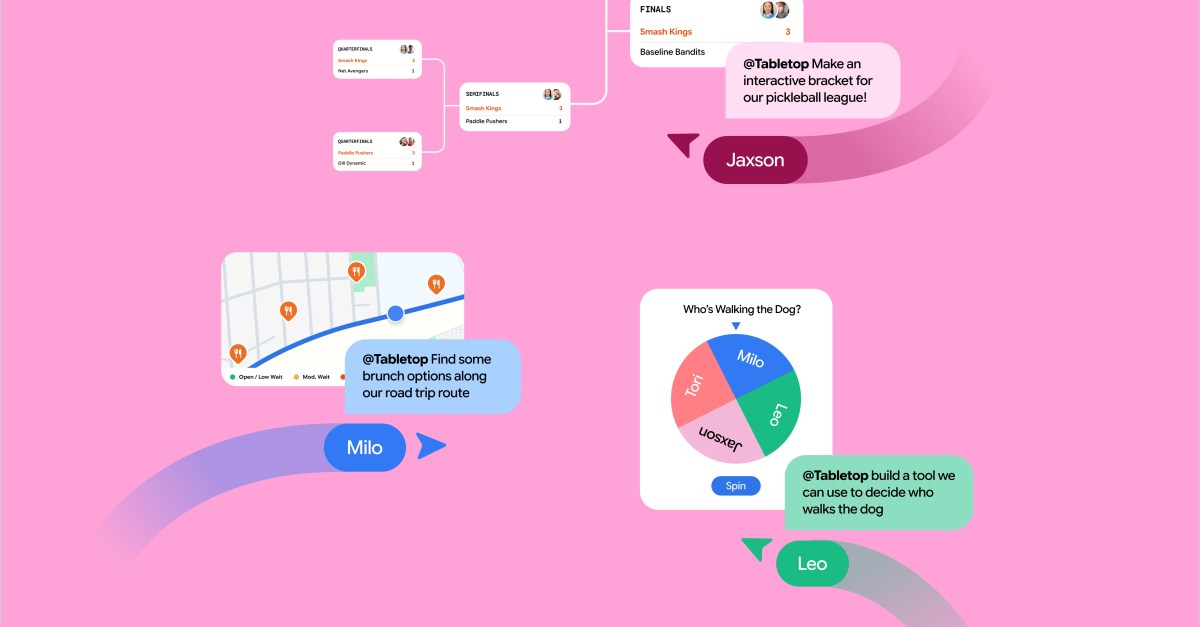
Google introduced Tabletop, an AI-driven platform that creates custom collaborative spaces for personal planning, currently available in beta for users over 18 in the United States.
Google unveils Tabletop AI platform
Google has launched Tabletop, an experimental AI tool designed to let users build personalized collaborative hubs. The service targets everyday planning tasks such as family projects, group trips, or shared chores. Its interface resembles workplace managers like Asana and Monday, but adds a natural‑language AI layer. Tabletop is part of Google Labs’ effort to bring generative AI into routine productivity workflows.

Roman Nurik, design and engineering lead at Google Labs, describes Tabletop as a “Google Doc for family and friend projects.” Users add links, files, and ideas, then invoke @tabletop or select a starter template to let the AI generate interactive tools. Examples include trip itineraries, dinner polls, expense splitters, and tournament brackets. Once a space is ready, a shareable link can be dropped into a group chat for real‑time collaboration.
AI creates custom collaborative tools
Tabletop’s “vibecode” feature lets users describe a desired tool—such as a savings tracker, chore chart, or event plan—and the AI builds a functional interface on the fly. The generated components can be rearranged, linked to external resources, or populated with data directly in the browser. Because the output lives in a web app, no additional software installation is required. This approach aims to replace heavyweight enterprise solutions for simple personal projects.
In a demo video, Nurik shows the AI instantly producing a travel expense table and a restaurant‑voting poll for a group of friends. Both tools update in real time and can be shared via a simple URL, mirroring the collaborative experience of Google Docs. Users can also save their spaces for future reuse, reducing setup time for recurring activities. The seamless sharing and live editing model is intended to boost group coordination without the learning curve of traditional project‑management apps.
Beta limited to US adults over 18
Tabletop is currently in a closed beta accessed through a waitlist. At present, eligibility is restricted to individuals aged 18 or older residing in the United States. Google has not announced when or if the program will expand to other regions or age groups. Nurik hinted that future iterations might allow younger family members, suggesting the current age gate is a temporary testing measure.
The age restriction likely reflects compliance considerations around data privacy for minors. Google may relax the rule once sufficient feedback is gathered from the adult beta cohort. Interested users can sign up on the official Tabletop page to receive an invitation when slots open. The limited rollout also creates an early community of power users who can shape the product’s direction.
Potential impact on personal planning
If Tabletop expands beyond the beta, it could become a lightweight alternative to enterprise tools for everyday family and friend coordination. Its AI‑driven customization and instant sharing may attract users who find traditional platforms too rigid or costly. Integration with Google’s broader ecosystem—Drive, Calendar, and Docs—could further cement its utility in everyday workflows.
As generative AI continues to permeate consumer applications, Tabletop serves as a concrete example of AI‑assisted planning. Analysts will watch adoption rates and user feedback to gauge whether the concept can scale globally. Success could prompt Google to embed similar AI features across its suite of productivity services, reshaping how personal projects are organized online.
TechTimes analysis
TechTimes believes Tabletop marks a strategic move for Google to embed generative AI into everyday coordination tasks, a space traditionally dominated by enterprise tools like Asana and Monday. By offering a free, AI‑powered alternative that integrates with Google’s existing services, the company could capture a new segment of users seeking simple, collaborative solutions for personal projects. The current US‑only, adult‑only beta allows Google to fine‑tune privacy and usability, but the real test will be how quickly the service can scale globally and whether it can maintain a frictionless experience as feature sets expand.