


Sony is bringing its latest AI-powered image upscaling technology to the standard PlayStation 5, giving developers a new way to improve visual quality without requiring players to upgrade to the more powerful PS5 Pro.
Sony has introduced Quick Spectral Super Resolution (QSSR), a new AI-based upscaling technology designed specifically for the standard PlayStation 5. The technology is the result of Sony’s ongoing Project Amethyst collaboration with AMD and is intended to extend advanced image reconstruction techniques to the much larger installed base of standard PS5 consoles.
Sony positions QSSR as a new performance tier within its AI upscaling technology. The company continues to describe PlayStation Spectral Super Resolution (PSSR), which is available on the PS5 Pro, as its highest-end solution, while QSSR is designed around the more limited processing capabilities of the standard PS5.
QSSR is designed around the standard PS5 hardware
The biggest difference between QSSR and PSSR comes down to the hardware available underneath. Unlike the PS5 Pro, the standard PS5 does not include dedicated machine-learning silicon, meaning Sony has had to develop QSSR around a different balance between image quality and processing performance.
Early testing by Digital Foundry suggests that QSSR does not operate at the same level as PSSR on the PS5 Pro. Rather than consistently targeting an upscaled 4K presentation, games using QSSR on the standard PS5 may work closer to a 1440p output depending on the selected graphics mode and the way developers configure their rendering pipeline.
Daniel Craig, Sony’s principal graphics R&D engineer, explained that developers have considerably more flexibility on PS5 Pro, where games can generally target a 4K output while dynamically adjusting the internal rendering resolution. On the standard PS5, developers need to make broader adjustments to rendering resolution as well as intermediate and final presentation targets.
This approach allows QSSR to operate within the performance limits of the existing PS5 hardware while still offering developers another tool to improve image clarity.
Developers can integrate QSSR without major changes
One of QSSR’s potentially important advantages is how easily it can be incorporated into existing games. Sony says the technology can essentially serve as a drop-in replacement for titles that already support PSSR, with only a few days of tuning required in some cases.
That could lower the barrier for developers looking to bring AI-assisted image reconstruction to existing PS5 titles. Sony also says QSSR will be made broadly available to PlayStation developers rather than being restricted to a small number of first-party projects.
The broader availability could be particularly useful for studios that want to improve image quality while maintaining existing performance targets. Instead of rebuilding a game’s entire graphics pipeline, developers may be able to adapt existing rendering configurations for the new technology.
Marvel’s Wolverine and Ghost of Yōtei lead the rollout
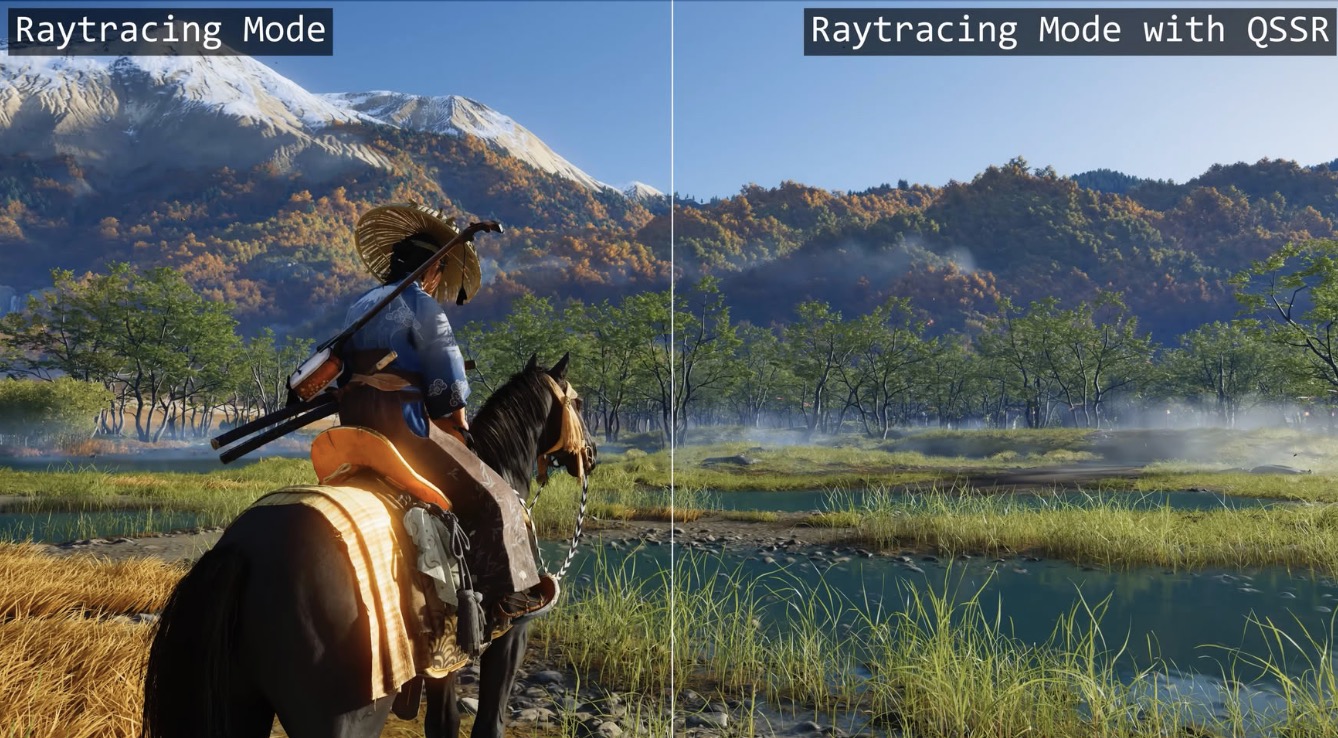
Sony is launching QSSR with two games: Marvel’s Wolverine and Ghost of Yōtei. Both titles are receiving updates that add QSSR as an additional graphics option on the standard PS5.
The rollout coincides with the release of the Ghost of Yōtei Complete Edition, giving players an early opportunity to compare the new technology with other available rendering options. Sony’s demonstrations suggest that QSSR can produce a somewhat sharper image, particularly in fine details and areas where traditional upscaling can introduce softness.
The first implementations will also provide a useful indication of how much visual improvement developers can extract from QSSR without compromising frame rates or other graphical settings.
AI upscaling expands beyond the PS5 Pro
The arrival of QSSR represents another step in Sony’s effort to bring AI-assisted graphics technologies to a wider range of PlayStation hardware. While PSSR remains associated with the more powerful PS5 Pro, QSSR addresses a different challenge: improving image reconstruction on the considerably larger base of standard PS5 consoles.
Image reconstruction has become increasingly important as modern games attempt to balance higher visual fidelity with demanding performance targets. Rendering every frame at native 4K can place a substantial load on the GPU, making technologies that reconstruct a higher-resolution image from a lower-resolution render increasingly valuable.
The effectiveness of QSSR will ultimately depend on how individual developers implement it, including their choice of internal rendering resolution, graphics settings and performance targets. Still, by making the technology broadly available, Sony is giving PS5 developers another option for improving image quality without requiring players to move to the PS5 Pro.