



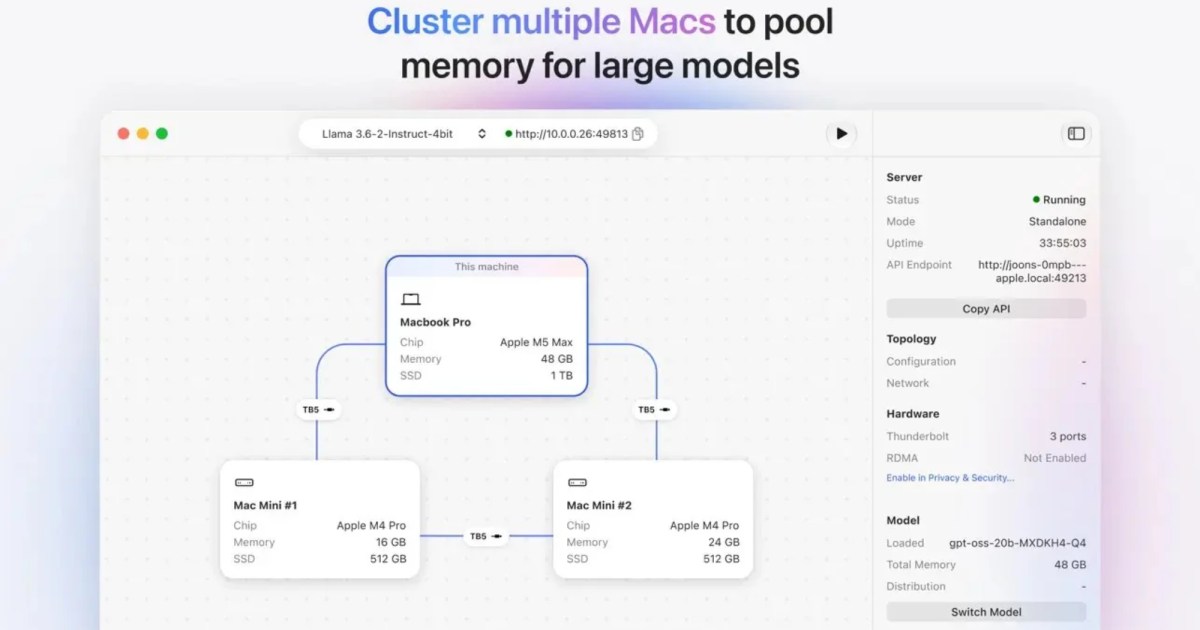
Apple is testing the Harbor app, a macOS tool that lets Macs run open‑weight AI models locally without cloud services, promising quick setup and data privacy.
Harbor enables on‑device AI model execution
Harbor is a macOS application being trialed by Claris, Apple’s FileMaker subsidiary, that allows Apple‑silicon Macs to run publicly available open‑weight models such as OpenAI’s gpt-oss-20b. Users can download the model from Hugging Face and launch it within minutes, without any command‑line interaction. All inference runs on the local hardware, eliminating cloud‑based processing and per‑token billing. This approach addresses growing concerns over data privacy when using AI tools.

According to leaked screenshots, Harbor’s interface lets users select, download, and start a model with a few clicks, requiring no terminal expertise. The app also supports automatic updates for newer model versions, ensuring continued performance without interrupting workflows. By keeping computation on the machine, enterprises can retain tighter control over sensitive data and comply with stricter regulatory standards.
Multi‑Mac clustering via Thunderbolt 5
Harbor can link two or more Thunderbolt 5‑compatible Macs, pooling their unified memory to accelerate local processing. When connected, the software automatically detects the machines and creates a shared resource pool, delivering faster inference than a single Mac’s CPU and memory alone. It leverages RDMA (Remote Direct Memory Access) introduced in macOS Tahoe 26.2 to read memory across machines directly, reducing latency and boosting bandwidth.
RDMA over Thunderbolt 5 allows one Mac to access another’s memory without involving the host CPU, markedly speeding up large models such as the 20‑billion‑parameter gpt‑oss‑20b. Analysts suggest that scaling the cluster to dozens of Macs could approach the performance of dedicated GPU servers while preserving the security benefits of on‑device processing.
Current status and next steps
Harbor’s App Store listing appeared on 10 November 2026 and was removed the same day, indicating the product is still in a private preview. Claris is collecting early‑access sign‑ups via a form but has not disclosed pricing, a launch date, or whether the app will be free. The brief disappearance does not appear to signal cancellation, but the timeline remains uncertain.
In the meantime, users can turn to existing solutions such as LM Studio for single‑Mac inference or the open‑source Exo project for clustering, though both require terminal work. Harbor aims to combine the capabilities of these tools with a graphical interface and streamlined setup, potentially lowering the barrier for small and midsize businesses to adopt private AI workloads.
TechTimes analysis
TechTimes believes Harbor app represents a significant move toward on‑premise AI, merging local model execution with a user‑friendly GUI and Thunderbolt‑5 clustering. If Apple finalises RDMA support and expands model compatibility, Harbor could challenge cloud‑based AI services while satisfying heightened privacy demands. The market will watch Apple’s pricing strategy and integration depth with macOS, as well as how quickly developers adopt the platform for enterprise workloads.