



AMD’s next-generation Zen 6 architecture could bring a major leap forward for Ryzen gaming processors, combining up to 12 high-performance cores and 48MB of shared L3 cache per chiplet with deeper architectural improvements and the potential for significantly larger 3D V-Cache configurations.
AMD is preparing a new generation of processor architecture that could reshape expectations for high-performance desktop CPUs. Its upcoming Zen 6 design is expected to increase the number of cores per chiplet from eight to 12 while expanding shared L3 cache capacity by 50%.
However, the improvements go beyond adding more processing cores. AMD is also redesigning several internal components to improve instructions per clock (IPC), strengthen execution efficiency, and reduce performance bottlenecks.


Although the company has not officially introduced consumer Ryzen processors based on Zen 6, recently disclosed technical details from its next-generation Epyc Venice server platform provide an early look at what could eventually arrive in desktop CPUs.
For gamers, the combination of more cores, improved per-core performance, and larger cache capacity could be particularly interesting, especially if AMD carries these developments into future Ryzen X3D processors.
Zen 6 Brings 12 Cores to a Single Chiplet
One of the most significant changes in Zen 6 concerns the Core Complex Die (CCD), the component that groups CPU cores together with a shared pool of L3 cache.
With Zen 5, each CCD supports up to eight cores and 32MB of L3 cache. Zen 6 increases those figures to 12 cores and 48MB, representing a 50% improvement in both core count and cache capacity.
This change could have important implications for AMD’s desktop processor lineup.
Current 12-core Ryzen processors based on Zen 5 require two separate CCDs because each chiplet accommodates only eight cores. While this configuration provides additional processing capacity, communication between separate chiplets can introduce latency compared with communication between cores located on the same CCD.
For certain gaming workloads, where multiple threads need to exchange information quickly, that additional latency can become a limiting factor.
Zen 6 could eliminate much of this complexity for future 12-core processors. By fitting all 12 cores and 48MB of L3 cache into a single CCD, AMD would allow more workloads to run within one shared processing complex.
Games capable of utilizing more than eight CPU cores could potentially benefit from this arrangement without distributing their workloads across multiple chiplets.
However, the gains will depend heavily on individual game engines. Titles that primarily rely on a handful of critical threads, or already operate efficiently within a single CCD, may see smaller improvements.
The new design could also provide a more flexible foundation for higher-core-count processors. With 12 cores per CCD, AMD could theoretically build 24-core Ryzen processors using two chiplets.
Architectural Improvements Could Make Every Core Faster
Increasing core density is only part of AMD’s Zen 6 strategy. The company is also introducing substantial changes to the internal architecture to improve performance at the individual core level.
One important metric is instructions per clock, commonly known as IPC. It measures how much work a processor can complete during each clock cycle, making it particularly relevant for applications that depend heavily on CPU performance.
AMD’s recently disclosed technical data indicates that its denser Zen 6c architecture delivers approximately 27% higher geometric-mean IPC across selected AI and server workloads.
This figure should not be interpreted as a gaming performance improvement or a direct measurement of the full-performance Zen 6 cores. Nevertheless, it highlights the scale of architectural changes AMD is pursuing.
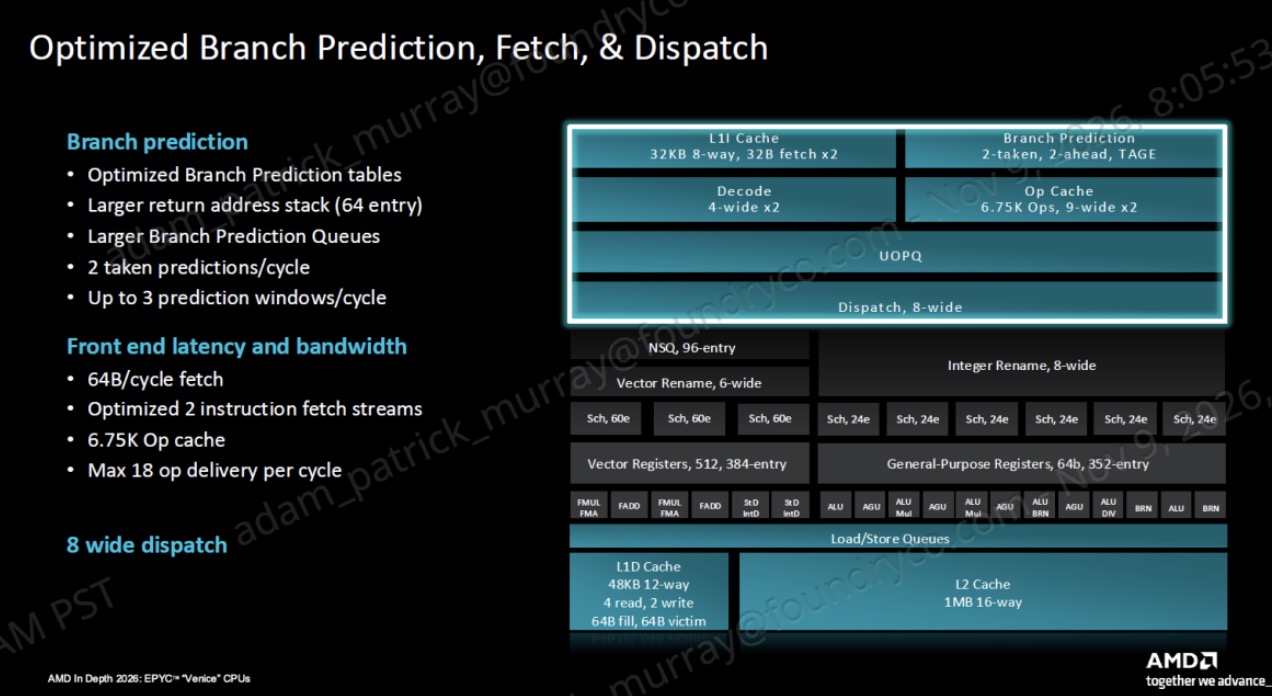
Among the improvements is a redesigned branch prediction system. Zen 6 introduces larger prediction queues, a 64-entry Return Address Stack, and the ability to predict two taken branches per cycle.
Branch prediction allows a processor to anticipate which instructions should be executed next. More accurate predictions help keep the CPU’s execution pipeline busy, while faster recovery from incorrect predictions reduces wasted processing time.
AMD is also expanding its operation cache to approximately 6,750 operations. The front end can deliver up to 18 operations per cycle, supported by improvements in instruction fusion and execution resources.
Together, these changes are designed to help individual cores process instructions more efficiently and maintain a consistent flow of useful work.
For gaming, that could be just as important as increasing the total number of cores.
Many modern games still depend heavily on a relatively small number of demanding CPU threads. Improving branch prediction, instruction delivery, and execution efficiency could therefore produce tangible benefits even when a game does not fully utilize all 12 cores.
TSMC’s 2nm Process Could Improve Efficiency
Another important aspect of AMD’s next-generation platform is its manufacturing technology.
The Epyc Venice processors are being developed using TSMC’s 2nm manufacturing process, which is expected to offer improvements in transistor density and power efficiency.
The new process could also provide additional opportunities to increase operating frequencies in certain configurations.
However, AMD has not confirmed whether upcoming consumer Ryzen processors will use identical manufacturing specifications or achieve the same operating characteristics.
Historically, Ryzen and Epyc processors have shared the underlying Zen architecture, although their final implementations differ according to their respective markets and design requirements.
As a result, Venice provides useful insight into AMD’s architectural direction, but actual Ryzen specifications will need to be confirmed separately.
144MB of 3D V-Cache Could Be a Game Changer
Perhaps the most intriguing possibility for future gaming processors comes from AMD’s Venice-X server design.
This configuration demonstrates how a 12-core CCD could be paired with as much as 144MB of L3 cache.
The total consists of 48MB of integrated L3 cache and an additional 96MB of stacked 3D V-Cache.
For comparison, current eight-core Ryzen X3D processors offer approximately 96MB of total L3 cache.
AMD has not announced a consumer Ryzen processor featuring 12 cores and 144MB of L3 cache. However, the Venice-X configuration demonstrates the potential of combining a higher core count with a substantially larger shared cache.
This is particularly relevant because 3D V-Cache has become one of AMD’s most important competitive advantages in gaming.
By placing additional cache directly on the processor package, AMD can keep more frequently accessed game data close to the CPU cores. This reduces the need to retrieve certain information from system memory, which is considerably slower.
Depending on the game and workload, the larger cache can improve frame rates and reduce performance inconsistencies.
A future 12-core Ryzen X3D processor with 144MB of L3 cache could therefore combine several advantages: additional processing cores, improved IPC, and a significantly larger pool of high-speed cache.
Such a design could also simplify workload management.
Some existing dual-CCD Ryzen X3D processors require scheduling mechanisms to direct gaming workloads toward the chiplet equipped with additional 3D V-Cache. A single CCD with all 12 cores sharing a large cache could make this process less complicated.
Could Zen 6 Solve the Gaming Versus Productivity Trade-Off?
AMD’s Ryzen X3D processors have established a strong reputation among gamers, particularly models featuring eight cores and additional 3D V-Cache.
These processors have demonstrated that a carefully optimized architecture and larger cache can sometimes deliver better gaming performance than simply increasing the number of CPU cores.
Meanwhile, Ryzen 9 processors target users who need greater multi-threaded performance for content creation, professional applications, and demanding workloads.
This creates an interesting purchasing decision: choose an eight-core X3D processor optimized for gaming or move to a higher-core-count Ryzen 9 for additional productivity performance.
Zen 6 could potentially narrow that gap.
A 12-core Ryzen X3D processor built around a single CCD would combine more processing capacity with the gaming advantages of 3D V-Cache.
For users who regularly switch between gaming, video editing, content creation, and multitasking, such a configuration could offer a more balanced experience.
Nevertheless, the final results will depend on several factors, including clock speeds, power limits, thermal characteristics, operating system scheduling, and AMD’s implementation of 3D V-Cache.
Not every game benefits equally from additional cache or CPU cores. Some titles are more sensitive to clock speeds, while others respond more strongly to memory latency and cache capacity.
Independent benchmarks will ultimately determine how much of an advantage Zen 6 delivers in real-world gaming.
AMD’s Next Gaming CPU Could Be Its Most Balanced Yet
The early details surrounding Zen 6 suggest that AMD is pursuing a broader architectural upgrade rather than simply increasing core counts.
The combination of 12 cores per CCD, 48MB of native L3 cache, improved execution capabilities, and the potential for 144MB of total L3 cache with 3D V-Cache could provide a compelling foundation for future Ryzen processors.
If AMD brings these capabilities to its consumer X3D lineup, the company could address one of the longstanding compromises in high-performance desktop CPUs: balancing gaming performance with multi-core productivity.
A single-chiplet 12-core Ryzen X3D processor would be particularly interesting because it could deliver more cores without requiring games to distribute critical workloads across separate CCDs.
Of course, these possibilities remain speculative until AMD officially introduces its Zen 6-based Ryzen products. Server architectural disclosures cannot replace independent gaming benchmarks, and the final consumer implementations may differ from the configurations demonstrated on Venice.
Still, the direction is promising.
AMD’s next major gaming processor could be more than another incremental upgrade. It could combine the core-count advantages of Ryzen 9 with the cache-driven gaming strengths of Ryzen X3D, potentially delivering a much more versatile CPU for enthusiasts and demanding PC users.