


According to new research from Omdia, India’s PC market (excluding tablets) reached a record high in 2025, with strong notebook sales driving growth, while rising component costs cast a shadow over 2026 prospects.
In the fourth quarter of 2025, PC shipments in India totaled 4.0 million units, up 17% year-on-year. Notebook demand led the growth, reaching 3.2 million units, a 22% increase fueled by festive season buying, aggressive online promotions, and retailers clearing year-end inventory. Desktop shipments saw more modest growth, rising 2% to 871,000 units, supported by steady purchases from enterprises and institutions. Tablets grew slightly in Q4, reaching 1.1 million units, a 3% increase, as consumer interest and promotional activity offset weaker education-driven demand.
For the full year, India’s PC shipments hit 15.9 million units, up 12.5% from 2024, marking the highest annual total ever recorded in the country. Notebook shipments accounted for most of this growth, climbing 15.2% to 12.3 million units, while desktops grew 4% to 3.6 million units. In contrast, tablet shipments fell 18% to 4.9 million units, primarily due to delays in government education programs. Excluding the education segment, however, the tablet market actually grew 12.8%, reflecting robust consumer demand.
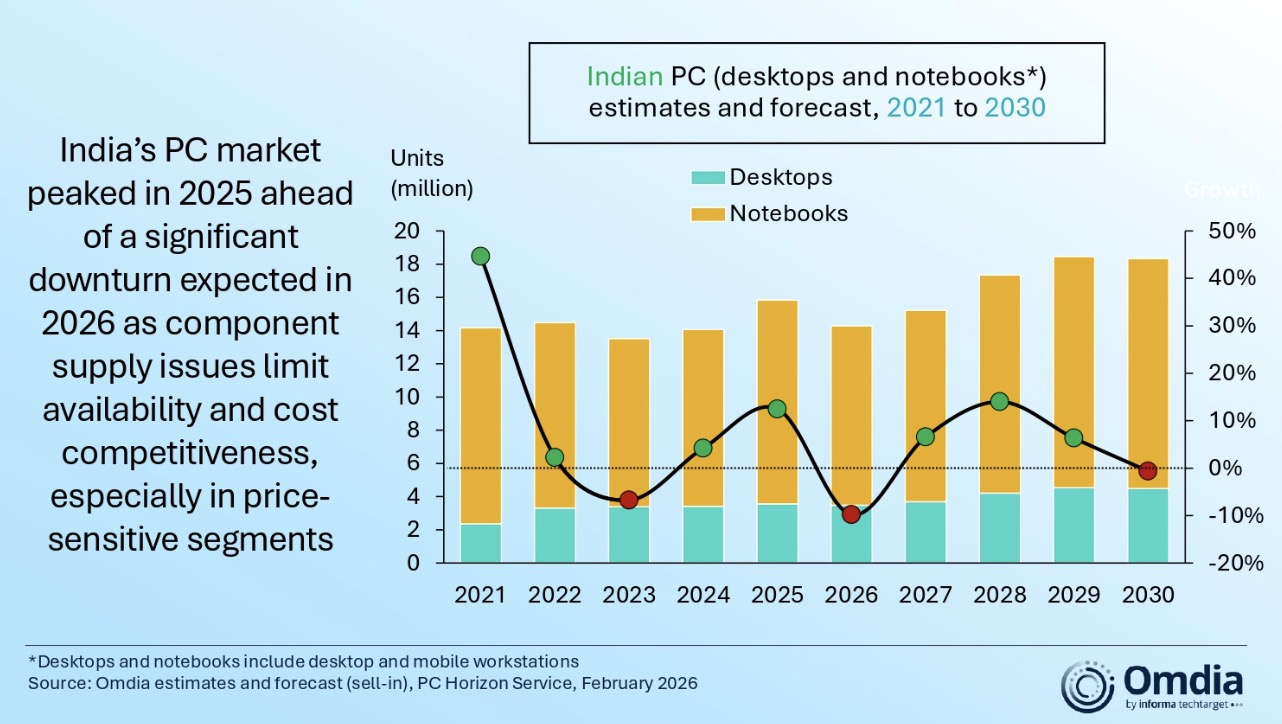
Looking ahead to 2026, the market faces headwinds from rising component costs, which are expected to impact both device affordability and availability. “Memory and storage price increases are particularly significant, but processor and GPU costs are also trending higher,” said Ashweej Aithal, Senior Analyst at Omdia. “We expect total PC shipments to fall to 14.3 million units, a 9.8% decline from 2025, as the market adjusts following a record year.” The tablet market is projected to grow modestly by 2.1% to 5.0 million units, largely driven by delayed education tenders coming into execution.
Rising component prices are expected to influence buyer behavior across segments. Aithal noted that mainstream consumer and entry-level commercial PCs will be most affected due to higher price sensitivity. While vendors may offset some of the cost increases through promotions, sustained price pressures are likely to dampen demand in price-sensitive segments.
India’s PC education segment declined 5% in 2025 because of delays in institutional procurement. However, the ELCOT program, which began execution late last year, may boost education-related PC shipments in 2026. The overall commercial PC market is expected to shrink by 8% in 2026, whereas the education segment could see 14% growth as new tenders are implemented. “Education procurement continues to be a critical driver for India’s PC market, with upcoming tenders likely to shape market momentum,” Aithal said.
Tablet shipments were mixed, with total volumes down 18% to 4.9 million units. The commercial tablet segment fell 52%, reflecting postponed government education purchases and cautious SMB and enterprise spending. Consumer tablet demand, however, grew 21%, supported by festive promotions, strong online and offline demand, and aggressive vendor campaigns.
Despite slowing entry-level demand due to rising costs, Aithal suggested the trend could accelerate premium adoption in both PC and tablet markets. “As entry-level devices become more expensive, consumers are more likely to consider higher-spec models, narrowing the gap between mainstream and premium devices, and driving upgrades to systems with better performance and longer lifecycles,” he said.