



GENTO showcased its proprietary 21-DoF dexterous hand at the CoRL 2026 conference in Austin, Texas, alongside TIANJI force‑controlled arms, the Marvin Pro platform and the Luna mobile robot.
The 21‑DoF dexterous hand from GENTO made its world debut at CoRL 2026, the Conference on Robot Learning held November 9‑12 in Austin, Texas. The prototype was displayed at Booth 602, Level 3 of the JW Marriott, together with TIANJI force‑controlled arms, the Marvin Pro dual‑arm platform and the Luna mobile robot, with the exhibit open until 1 p.m. on November 11.
GENTO’s approach relies on a single linkage‑driven transmission that simultaneously reduces backlash, hardens the transmission against impacts, makes every joint backdrivable and boosts fingertip force within the same finger envelope. The low‑clearance linkage eliminates mechanical play that normally degrades repeatability.

The backdrivable joints allow external forces to move the fingers rather than meeting rigid resistance. Coupled with MIT’s hybrid force/position control, the hand can comply with contact, stiffen when heavy loads are detected, and stay safe around humans.
Efficient force transmission through the linkage yields higher rated fingertip force without increasing finger size, addressing a key limitation of many existing dexterous hands that sacrifice strength for compactness.
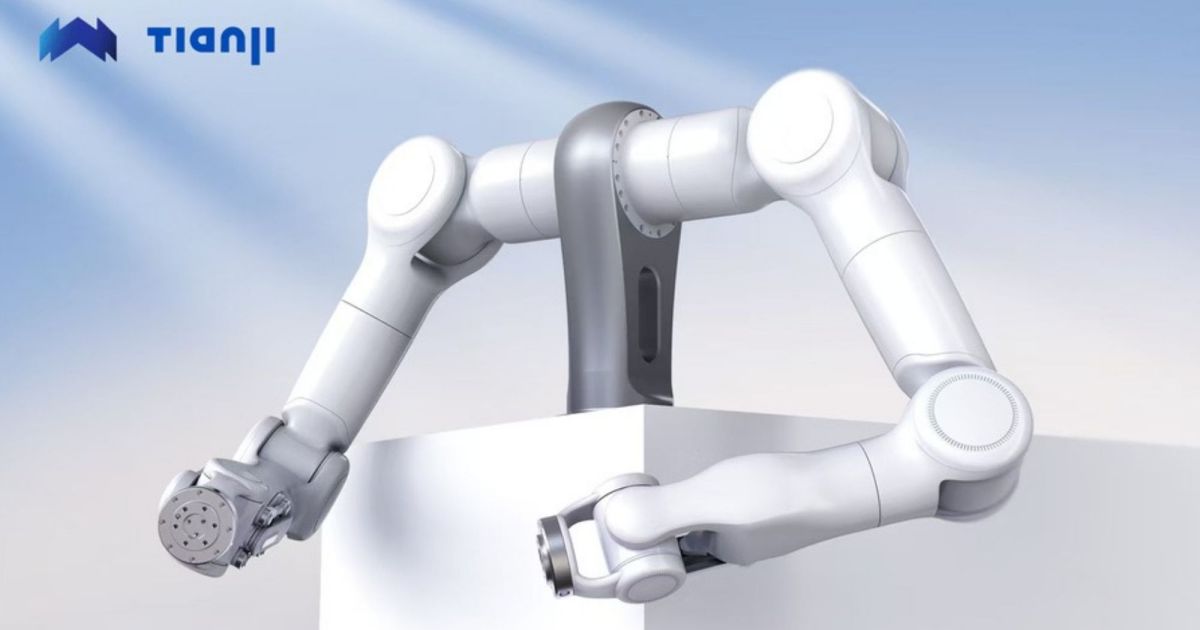
TIANJI Intelligence equips the hand and its M6‑Lite, M6 and M20 arm families with in‑house MEMS joint torque sensors. The sensors resolve torques as low as 0.02 N·m, operate with a 160 Hz torque‑loop bandwidth and achieve repeat positioning accuracy of ±0.03 mm.
Each joint module integrates motor, reducer, driver, encoder and brake into a single unit that is roughly 25 % lighter than comparable offerings from major competitors, improving dynamic response and reducing overall arm weight.
In May 2026, TIANJI released open‑source benchmark scripts on GitHub. Independent runs showed tracking error dropping from 10.56 mm to 1.89 mm and latency falling from 45 ms to 5 ms, confirming the system’s high‑speed, low‑error performance.
Alongside the hand, TIANJI displayed the Marvin Pro platform – a fixed‑base dual‑arm system built for teleoperation and real‑robot data collection. Visitors could issue voice commands that the platform parsed to locate and grasp specific objects from a cluttered scene.
At the same event, NVIDIA introduced GR00T 2, an open‑world action model built on NVIDIA Cosmos that predicts future video frames and robot actions together. Demonstrations used a TIANJI Marvin Pro equipped with two GENTO dexterous hands to execute a banana‑yogurt preparation task learned from human motion captured by a wearable exoskeleton.
GR00T 2 consumes the high‑frequency force data from the MEMS sensors, merges it with visual input, and generates executable robot trajectories. The seamless integration shows Marvin Pro can serve as a standard physical testbed for next‑generation embodied AI models.
TIANJI has built an end‑to‑end data workflow that links VR headsets, data gloves and a leader‑follower dual‑arm teleoperation setup. The system logs torque, vision and motion synchronously, then annotates and converts the data into formats ready for AI training.
The company estimates that a fleet of 100 Marvin Pro units could generate over 600,000 real‑robot demonstration datasets per year. Such a volume of force‑augmented data is expected to accelerate training for models like NVIDIA’s GR00T 2 and Shengshu Tech’s Motus2 world model.
TIANJI delivered more than 2,000 force‑controlled dual‑arm systems in the four months of mid‑2025, securing the top market share for force‑controlled arms. GENTO’s presence at CoRL reinforces TIANJI’s role as the execution layer behind many embodied‑AI research projects and commercial deployments.
By offering a high‑performance, backdrivable hand together with a scalable data collection infrastructure, GENTO and TIANJI are poised to meet the growing demand for robots that can both sense and adapt to physical contact, a capability that is increasingly critical for manufacturing, logistics and research applications worldwide.
Key specifications
| Parameter | Value |
|---|---|
| Degrees of freedom | 21 DoF |
| Torque sensor resolution | 0.02 N·m |
| Torque loop bandwidth | 160 Hz |
| Repeat positioning accuracy | ±0.03 mm |
TechTimes Perspective
TechTimes believes GENTO's debut of a 21‑DoF dexterous hand at CoRL 2026 marks a significant step toward closing the gap between AI reasoning and physical execution. The combination of ultra‑low‑latency MEMS torque sensing, backdrivable linkage design and a scalable data pipeline could lower the barrier for researchers to collect high‑quality force‑augmented datasets, accelerating embodied AI development. In Vietnam, the arrival of such technology may enable local manufacturers and research labs to adopt advanced manipulation robots more quickly, provided pricing and support structures are aligned with regional market expectations.